GI Endoscopy · 5 min read
Rutgeerts Score After Ileocolic Resection in 2026: What the Score Means and What To Do Next
A clinician-focused update on using the Rutgeerts score after Crohn's surgery, including why i2 still matters, why i1 is not trivial, and how surveillance at 6 to 12 months should drive treatment decisions.
Clinical Bottom Line
| Post-op finding | 2026 practical answer |
|---|---|
| First postoperative ileocolonoscopy | Still plan it at 6-12 months after ileocolic resection. This remains the key checkpoint for treatment adjustment. |
| Rutgeerts i0-i1 | Lower risk than i2-i4, but not a free pass. Newer data suggest even i1 deserves continued attention, especially if other risk factors persist. |
| Rutgeerts i2 | Treat this as meaningful endoscopic recurrence. The i2a versus i2b distinction is useful to know, but not reliable enough to ignore the whole i2 category. |
| Rutgeerts i3-i4 | High-risk recurrence. This is the clearest setting for treatment optimization and closer follow-up. |
| Smoking or no prophylactic therapy after surgery | Risk goes up. The endoscopic score should be interpreted alongside modifiable recurrence drivers, not in isolation. |
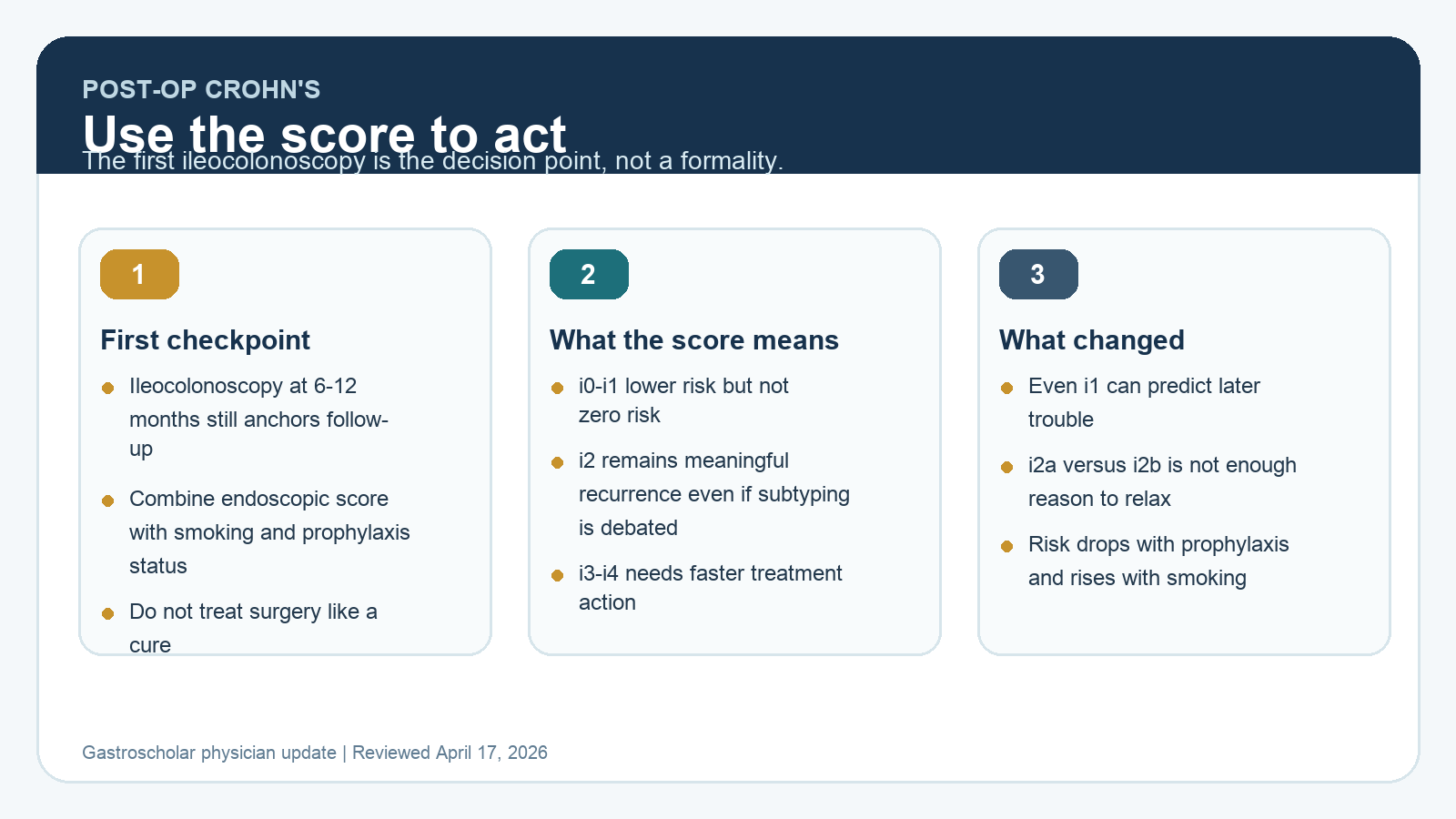
Endoscopy after Crohn's surgery is still mandatory, not optional
Postoperative Crohn's disease management is still anchored to endoscopic reassessment. The AGA postoperative algorithm continues to center follow-up ileocolonoscopy at 6-12 months after surgery, and the 2025 ACG guideline still treats postoperative endoscopy as the moment where prevention strategy becomes real management rather than theory.
For the practicing gastroenterologist, the implication is simple: surgery is not the end of monitoring. It is the reset point that makes structured surveillance matter even more.
What the Rutgeerts score still does well
The score remains clinically useful because it separates patients with little visible postoperative activity from those with meaningful early endoscopic recurrence. In the 2021 long-term cohort from Belgium and France, patients with i2, i3, or i4 lesions had worse clinical and modified surgical outcomes than those with i0 or i1 findings after a median 88 months of follow-up.
That basic message has not changed. More endoscopic activity still predicts more trouble.
Why the simple old interpretation is no longer enough
The part that has changed is how confidently we should talk about the middle of the score.
- i2 is not trivial. AGA still uses Rutgeerts i2 or greater as the threshold for treatment optimization after the first postoperative exam.
- i2a versus i2b remains unsettled. The 2023 individual-patient-data meta-analysis found no significant difference in clinical or surgical postoperative recurrence between i2a and i2b, supporting the same broad treatment strategy for the whole i2 group while better prospective data accumulate.
- Even i1 is not completely benign. In the 2024 Dutch modified Rutgeerts study, i1 was associated with clinical recurrence and progression to severe endoscopic recurrence. In the 2024 multicenter North American cohort, i1 at first colonoscopy predicted later recurrence among patients initially free of recurrence.
This is the part many older summaries miss. The score still matters, but the interpretation is more granular than "i0-i1 good, i3-i4 bad."
What the modified Rutgeerts data changed in practice
The 2024 modified Rutgeerts study included 652 patients after primary ileocecal resection and gives the cleanest recent numbers.
- Surgical recurrence rates rose from 7.7% at i0 and 5.3% at i1 to 12.9% at i2a, 19.1% at i2b, 28.8% at i3, and 47.8% at i4.
- Clinical recurrence occurred in 42.2% at i0, 53.7% at i1, 58.5% at i2a, 80.2% at i2b, 79.4% at i3, and 95.3% at i4.
- i2b, i3, and i4 were associated with surgical recurrence, while i1 and higher were associated with clinical recurrence.
The authors argued that ileal lesions deserve tighter monitoring and treatment optimization, while isolated anastomotic lesions may permit a more conservative approach. That is helpful nuance, but it still does not support complacency when the report says i2.
Risk factors still matter alongside the score
The score should never be read in a vacuum. The 2024 multicenter cohort found recurrence at the first postoperative colonoscopy in 29.9% of patients. Postoperative smoking increased recurrence risk, while prophylactic anti-TNF therapy reduced it substantially. The 2025 Dutch cohort also showed lower severe endoscopic and endoscopic-or-radiologic recurrence when postoperative prophylactic medication was used.
That is why a postoperative note that only lists the Rutgeerts score and stops there is incomplete. What matters is the combination of score, smoking status, prophylaxis, and whether therapy should be intensified now rather than later.
A practical way to use the score in clinic
| Finding | What to do with it |
|---|---|
| i0 | Continue current strategy, but keep scheduled monitoring and risk-factor review in place. |
| i1 | Do not panic, but do not dismiss it. Reassess smoking, prophylaxis, and follow-up timing carefully. |
| i2a or i2b | Treat as meaningful recurrence and discuss therapy optimization rather than assuming the subcategory settles the question. |
| i3 or i4 | Escalate management urgency. These patients are the clearest candidates for treatment intensification and tighter surveillance. |
| Any score plus active smoking or no prophylaxis | Interpret the endoscopy through a higher-risk lens and act accordingly. |
What to stop saying in 2026
- Stop describing i0 or i1 as if the patient is simply "safe."
- Stop pretending the i2a versus i2b distinction has fully settled management.
- Stop treating the postoperative colonoscopy as a box to check rather than the main decision point after surgery.
- Stop separating the score from smoking status, prophylaxis, and treatment escalation planning.
Selected references
- AGA Guideline on Management of Crohn's Disease After Surgery. Clinical decision support tool.
- ACG Clinical Guideline: Management of Crohn's Disease in Adults. Am J Gastroenterol. 2025.
- Rates of Postoperative Recurrence of Crohn's Disease and Effects of Immunosuppressive and Biologic Therapies. Clin Gastroenterol Hepatol. 2021.
- Comparison of the Risk of Crohn's Disease Postoperative Recurrence Between Modified Rutgeerts Score i2a and i2b Categories: An Individual Patient Data Meta-analysis. J Crohns Colitis. 2023.
- Prognostic Value of the Modified Rutgeerts Score for Long-Term Outcomes After Primary Ileocecal Resection in Crohn's Disease. Am J Gastroenterol. 2024.
- Clinical Predictors of Early and Late Endoscopic Recurrence Following Ileocolonic Resection in Crohn's Disease. J Crohns Colitis. 2024.
- The Impact of Postoperative Prophylactic Medication on Long-Term Surgical, Severe Endoscopic and Endoscopic or Radiologic Recurrence Following Primary Ileocecal Resection in Patients With Crohn's Disease. Aliment Pharmacol Ther. 2025.
Last reviewed April 17, 2026. This update is written for clinicians using the first postoperative ileocolonoscopy to decide whether Crohn's disease prevention after surgery is actually working.
Topics
For your teaching file
Save this article as a PDF
Drop your email and we'll open a print-ready version you can save as a PDF — and you'll start getting our weekly GI endoscopy newsletter.