GI Endoscopy · 4 min read
Post-Polypectomy Surveillance in 2026: Assigning the Next Colonoscopy Interval After a High-Quality Exam
Current U.S. surveillance intervals for adenomas and serrated lesions, plus the quality requirements that must be met before a post-polypectomy interval can be trusted.
Clinical Bottom Line
| Baseline finding after a high-quality colonoscopy | Recommended interval |
|---|---|
| Normal colonoscopy | 10 years |
| 1-2 tubular adenomas <10 mm | 7-10 years |
| 3-4 tubular adenomas <10 mm | 3-5 years |
| 5-10 adenomas <10 mm, or any adenoma >=10 mm, villous features, or high-grade dysplasia | 3 years |
| >10 adenomas | 1 year and consider genetic evaluation |
| 1-2 SSPs <10 mm | 5-10 years |
| 3-4 SSPs <10 mm | 3-5 years |
| SSP >=10 mm, SSP with dysplasia, or TSA | 3 years |
| Piecemeal resection of adenoma or SSP >=20 mm | 6 months |
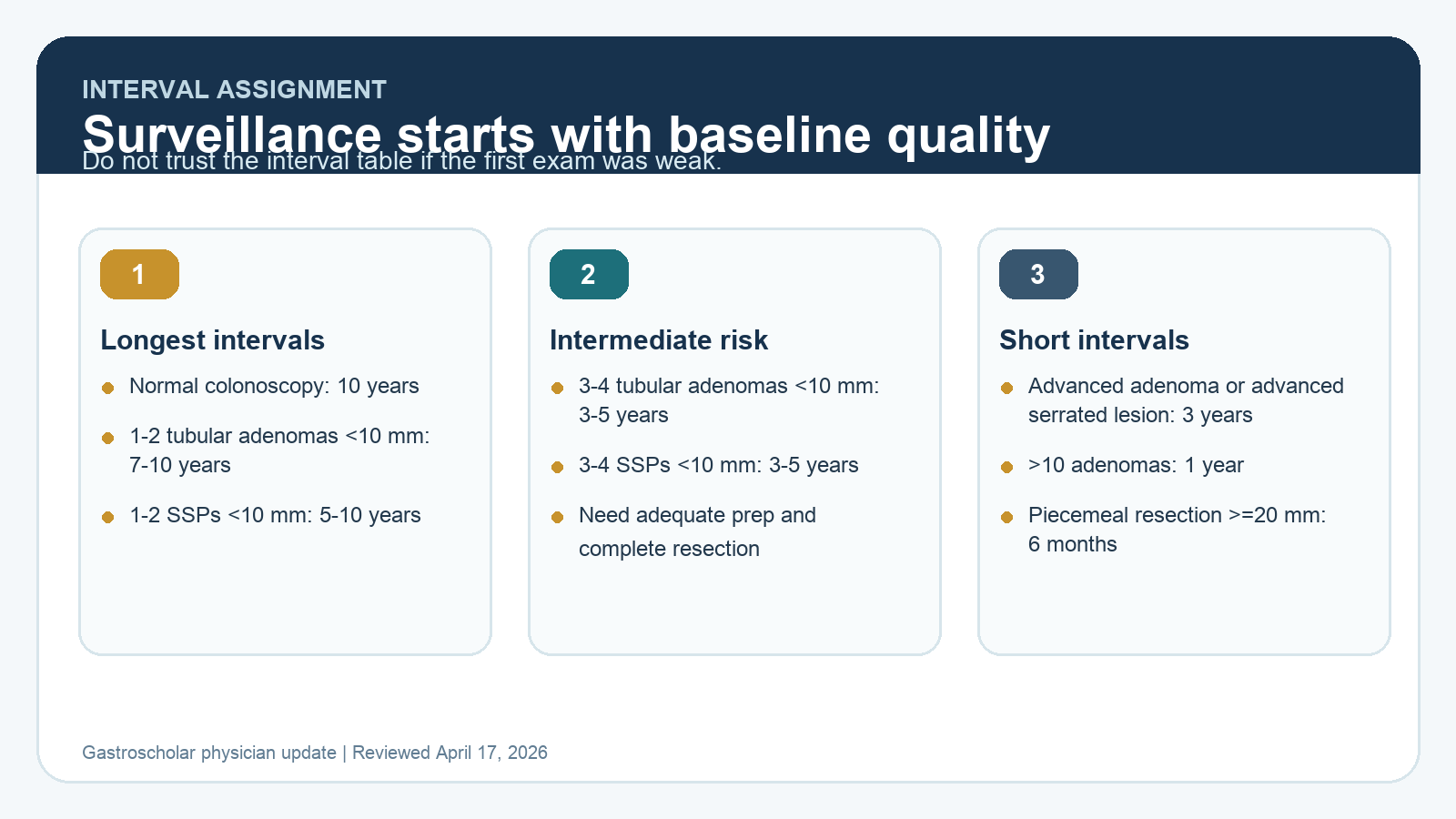
Surveillance intervals only apply after a high-quality baseline exam
Surveillance intervals are valid only after a high-quality baseline colonoscopy with adequate prep, complete cecal intubation, careful inspection, and confident complete resection. If that foundation is weak, the interval table becomes false reassurance.
What is still current in 2026
The core U.S. surveillance intervals are still anchored to the 2020 U.S. Multi-Society Task Force update. There has not been a new U.S. interval rewrite in 2025 or 2026. What has changed is the quality framework around the baseline exam:
- The 2024 ACG/ASGE quality indicators raised the bar for what counts as a high-quality colonoscopy.
- The 2025 bowel prep update defined "adequate" prep as prep good enough to assign standard screening or surveillance intervals.
- The 2024 AGA polypectomy update reinforced cold snare as the default technique for polyps <10 mm, which matters because incomplete or heat-distorted resection can distort downstream interval decisions.
Before assigning an interval, ask 5 questions
| Quality checkpoint | Why it changes surveillance decisions |
|---|---|
| Was the prep adequate? | If the prep was not good enough to detect clinically relevant lesions, standard intervals do not apply. |
| Was the exam complete to cecum? | An incomplete exam can downgrade a patient incorrectly into a lower-risk surveillance bucket. |
| Was inspection quality credible? | ADR, SSLDR, withdrawal technique, distention, cleaning, and fold exposure determine how much you can trust a "low-risk" result. |
| Was resection complete? | Piecemeal removal, difficult morphology, or uncertain margins shorten follow-up regardless of the simple interval chart. |
| Is this an average-risk patient? | These intervals do not override hereditary syndromes, inflammatory bowel disease surveillance programs, prior CRC resection, or major family-history pathways. |
The current quality bar is higher than many interval charts assume
The 2024 quality indicators are a major reason this topic deserves a refresh. Current priorities include bowel prep adequacy >=90%, cecal intubation >=95%, ADR >=35% across screening, surveillance, and diagnostic colonoscopies in adults older than 45 years, SSL detection rate >=6%, and an average withdrawal time closer to 8 minutes in normal examinations. If your baseline exam misses these marks, a nominal 7-10 year recommendation after 1-2 small adenomas is harder to defend.
Serrated lesions are where sloppy interval assignment still causes trouble
The current U.S. framework distinguishes clearly between low-burden and advanced serrated disease:
- 1-2 SSPs <10 mm: 5-10 years.
- 3-4 SSPs <10 mm: 3-5 years.
- SSP >=10 mm, SSP with dysplasia, or TSA: 3 years.
- Piecemeal resection of adenoma or SSP >=20 mm: 6 months.
This risk stratification is supported by newer serrated-neoplasia literature. A 2024 systematic review found higher metachronous risk with advanced serrated polyps and with serrated lesions >=10 mm compared with nonadvanced serrated lesions, which supports keeping advanced serrated findings out of the "stretch the interval" bucket.
Technique updates now affect interval credibility
Not every interval error comes from bad memory. Some come from poor baseline technique.
- AGA 2024: use cold snare for polyps <10 mm. Do not use hot forceps. Do not routinely clip defects <20 mm.
- USMSTF 2025: use split-dose prep as the standard, with same-day dosing reserved mainly for afternoon procedures.
- If prep is inadequate, reschedule within 12 months, or sooner when the indication was an abnormal noncolonoscopic screening test.
In other words, surveillance starts before pathology returns. It starts with whether the initial exam deserves to be trusted.
A practical way to use the 7-10 year interval
For average-risk patients with 1-2 small tubular adenomas, the evidence-based interval is 7-10 years, not 5 years. In practice, clinicians still individualize within that range based on baseline quality and patient-level context. A beautifully cleaned colon, confident complete cold snare resection, and a high-performing endoscopist support the longer end of the range. Borderline prep, uncertain completeness, or limited confidence in serrated detection push the recommendation toward the shorter end.
Selected references
- U.S. Multi-Society Task Force on Colorectal Cancer. Follow-up after colonoscopy and polypectomy. 2020.
- USMSTF updates bowel preparation recommendations. 2025.
- AGA clinical guidance on optimal bowel prep for quality colonoscopy outcomes. 2025.
- Rex DK, et al. Quality indicators for colonoscopy. Gastrointest Endosc. 2024.
- AGA Clinical Practice Update on common polyps and tailored polypectomy. 2024.
- Systematic review of metachronous risk after serrated polyps. 2024.
Last reviewed April 17, 2026. This summary is designed for clinicians assigning surveillance intervals after a technically credible baseline colonoscopy.
For your teaching file
Save this article as a PDF
Drop your email and we'll open a print-ready version you can save as a PDF — and you'll start getting our weekly GI endoscopy newsletter.