GI Endoscopy · 3 min read
Post-ERCP Pancreatitis Prevention in 2026: Rectal NSAIDs, Pancreatic Stents, and Practical Risk Reduction
A clinician-focused review of post-ERCP pancreatitis prevention, including rectal indomethacin timing, high-risk pancreatic stent use, wire-guided cannulation, and when aggressive hydration still matters.
Clinical Bottom Line
| Prevention step | 2026 practical answer |
|---|---|
| Rectal NSAIDs | Give rectal indomethacin 100 mg to most adults undergoing ERCP unless contraindications such as recent peptic ulcer disease or significant renal insufficiency are present. |
| Cannulation strategy | Wire-guided cannulation is preferred over contrast-guided cannulation to reduce PEP risk. |
| High-risk pancreatic duct access | Do not rely on NSAIDs alone when the pancreatic duct has been repeatedly or deeply accessed. Prophylactic pancreatic stenting still matters. |
| Hydration | Aggressive lactated Ringer's hydration remains reasonable in selected patients if heart failure, renal insufficiency, or advanced liver disease are not limiting factors. |
| Best mental model | PEP prevention is a bundled strategy, not a single suppository. |
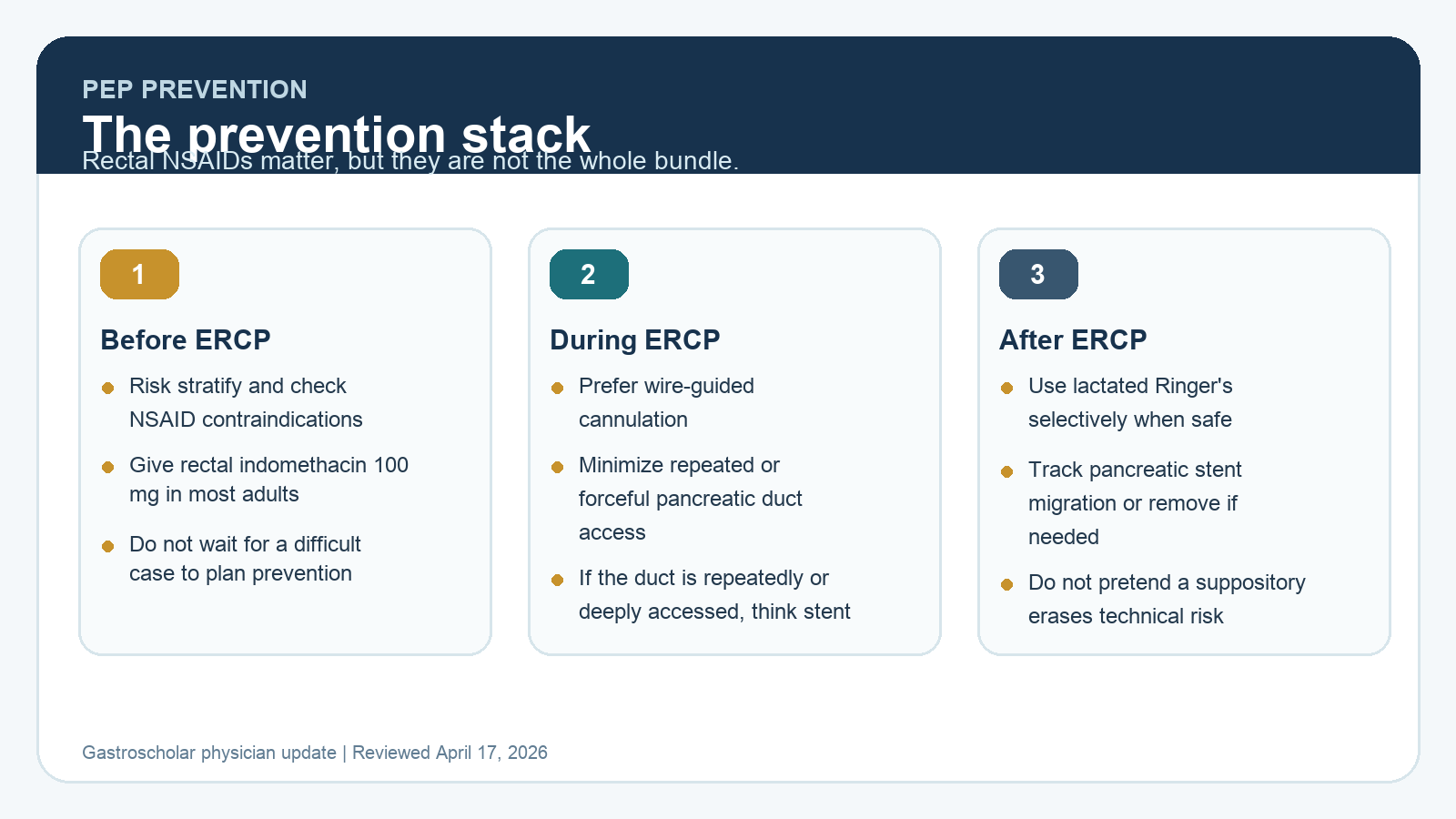
PEP prevention is a bundle, not a single trick
Rectal indomethacin remains a core part of prevention, but current practice is broader than a single-drug strategy. Post-ERCP pancreatitis prevention works best when the endoscopist treats it as a layered protocol that starts before cannulation, continues during the procedure, and does not ignore post-procedure physiology.
Busy doctors do not need another dramatic reminder that PEP is serious. They need a practical stack they can apply consistently.
What the ASGE guideline still tells us
The 2023 ASGE guideline remains the main U.S. procedural framework.
- Use preprocedural rectal NSAIDs for unselected ERCP patients and for high-risk patients, with indomethacin 100 mg as the standard adult dose.
- Prefer wire-guided cannulation over contrast-guided cannulation.
- Place a prophylactic pancreatic stent in high-risk patients when the pancreatic duct has been repeatedly or deeply accessed, and consider it more broadly in high-risk patients when duct access is easy.
- Use aggressive lactated Ringer's hydration selectively when cardiorenal or hepatic limitations do not make that unsafe.
That structure matters because it prevents the common mistake of treating NSAIDs as a reason to relax on technique.
The 2024 trial changed how to talk about indomethacin alone
The biggest recent practice-changing signal came from the randomized noninferiority trial comparing rectal indomethacin alone with indomethacin plus prophylactic pancreatic stent placement in 1950 high-risk patients. Post-ERCP pancreatitis occurred in 14.9% of the indomethacin-alone group versus 11.3% in the combination group. Indomethacin alone failed noninferiority and was inferior on post-hoc intention-to-treat analysis.
For clinicians, the message is simple: in a high-risk patient who meets the technical threshold for prophylactic pancreatic stenting, NSAID monotherapy is not the evidence-based shortcut.
Why the picture is still not perfectly settled
A 2024 high-risk rescue-cannulation cohort study of 607 patients found no additional benefit from indomethacin when patients were already receiving prophylactic pancreatic stents. That does not overturn the randomized trial. It does highlight a narrower unresolved question: once reliable stent-based drainage is achieved in selected high-risk settings, how much extra benefit does indomethacin still add beyond the broad guideline default?
Until stronger data resolve that point, the most defensible approach is still to follow the bundled ASGE strategy rather than trying to simplify it prematurely.
A practical prevention protocol for real-world ERCP
| Procedure phase | What to do |
|---|---|
| Before cannulation | Screen for NSAID contraindications, identify baseline PEP risk, and make the prevention plan explicit before starting. |
| During cannulation | Use wire-guided technique and avoid repeated contrast injection or forceful manipulation of the pancreatic duct. |
| If the pancreatic duct is repeatedly or deeply accessed | Treat the case as high risk and place a prophylactic pancreatic stent rather than assuming rectal indomethacin alone is enough. |
| Periprocedural hydration | When appropriate, use lactated Ringer's with a 20 mL/kg bolus and 3 mL/kg/h for 8 hours, recognizing that this is easier for inpatients and not suitable for everyone. |
| After the case | Track spontaneous stent migration or remove the stent in 2-4 weeks if needed, and do not miss early pain that reflects evolving PEP. |
What not to do in 2026
- Do not treat post-procedure rectal indomethacin as the entire prevention strategy.
- Do not ignore wire-guided cannulation principles and then expect prophylaxis to rescue poor technique.
- Do not skip pancreatic stent placement in a high-risk, repeatedly accessed pancreatic duct just because NSAIDs were given.
- Do not push aggressive hydration indiscriminately in patients with heart failure, renal insufficiency, or advanced liver disease.
Selected references
- ASGE Guideline on Post-ERCP Pancreatitis Prevention Strategies. 2023.
- Indomethacin with or without Prophylactic Pancreatic Stent Placement to Prevent Pancreatitis after ERCP: A Randomized Non-Inferiority Trial.
- Indexed record for the randomized indomethacin plus stent trial.
- Indomethacin Does Not Reduce Post-ERCP Pancreatitis in High-Risk Patients Receiving Pancreatic Stenting. Dig Dis Sci. 2024.
Last reviewed April 17, 2026. This update is written for clinicians standardizing ERCP risk-reduction protocols rather than treating PEP prevention as a single-drug decision.
Topics
For your teaching file
Save this article as a PDF
Drop your email and we'll open a print-ready version you can save as a PDF — and you'll start getting our weekly GI endoscopy newsletter.