GI Endoscopy · 4 min read
Cold Snare Polypectomy for Sub-10 mm Polyps in 2026: Where CSP Is Standard and Where It Is Not
A practical update on cold snare polypectomy for diminutive and small colorectal polyps, including technique, when hot resection is still reasonable, and what current guidelines say about clipping and forceps.
Clinical Bottom Line
| Polyp scenario | 2026 practical answer |
|---|---|
| Diminutive nonpedunculated polyp <=5 mm | Cold snare polypectomy is standard. Include a small cuff of normal tissue rather than shaving the lesion flush. |
| Small nonpedunculated polyp 6-9 mm | CSP remains the default approach because it is fast, effective, and safer than routine hot snare use for this size range. |
| Tiny 1-3 mm lesion in a technically awkward position | Cold forceps can be acceptable when CSP is technically difficult, but hot forceps should not be used. |
| Pedunculated lesion <=10 mm | Do not blindly apply the same rule as for sessile 4-9 mm lesions. Cold resection may be feasible, but immediate bleeding is more common and stalk management matters. |
| Routine clip closure after polypectomy defect <20 mm | Do not routinely place clips after standard small-polyp resection. |
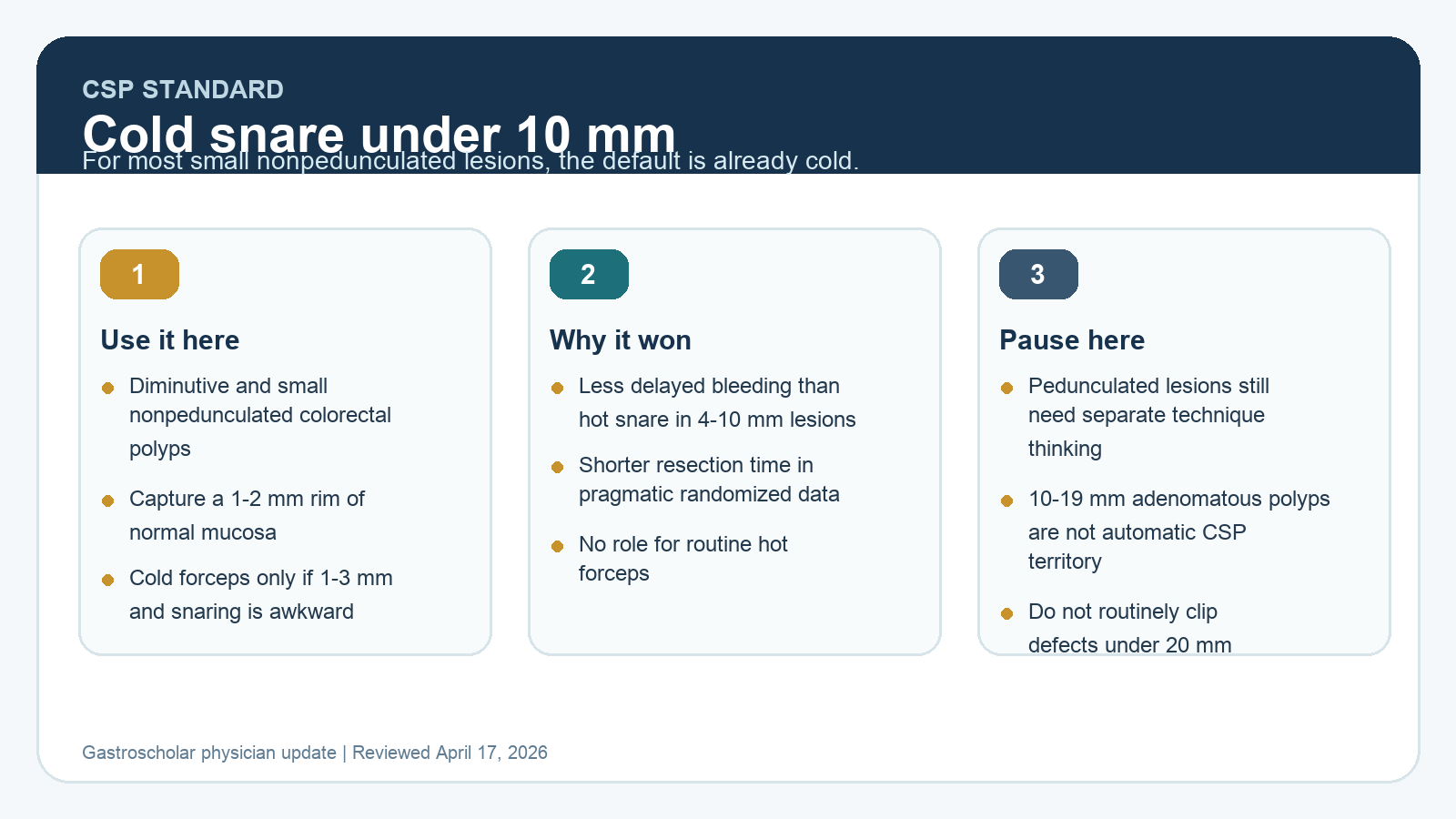
CSP is now the default for most polyps under 10 mm
This topic has matured. For the practicing colonoscopist, cold snare polypectomy is no longer a niche technique reserved for a few tidy diminutive lesions. Current AGA and ESGE guidance both place CSP at the center of routine resection for most nonpedunculated colorectal polyps under 10 mm, with a clear margin of normal tissue rather than a flush guillotine through the visible edge of the lesion.
The message for busy physicians is straightforward: if the lesion is nonpedunculated and under 10 mm, the default should usually be cold, not hot.
Why cold became the standard
The best practical randomized signal remains the 2023 pragmatic trial of 4270 participants with 4-10 mm colorectal polyps. Delayed bleeding occurred in 0.4% of patients treated with CSP versus 1.5% with hot snare. Severe delayed bleeding was also lower with CSP, and mean resection time was shorter at 119.0 seconds versus 162.9 seconds. Tissue retrieval, en bloc resection, and complete histologic resection did not meaningfully differ.
That is the kind of data that changes workflow. The case for hot snare in ordinary 4-9 mm lesions is weaker than many endoscopists still assume.
What good CSP actually looks like
| Technique point | Why it matters |
|---|---|
| Capture a 1-2 mm rim of normal mucosa | This improves complete resection and aligns with current AGA and ESGE guidance. |
| Use a dedicated cold snare when available | A thin, stiff snare improves clean mechanical transection and control of the resection plane. |
| Do not use hot forceps | Hot forceps add thermal injury without offering a good resection strategy for routine colorectal neoplasia. |
| Use cold forceps only selectively | Forceps should be a fallback for 1-3 mm lesions when CSP is technically difficult, not a routine replacement for CSP. |
| Do not reflexively clip the defect | For ordinary defects under 20 mm, routine clip closure adds cost and time without a clear guideline-supported benefit. |
Where the sub-10 mm rule becomes less automatic
Not every lesion under 10 mm should be treated as if it were the same small sessile adenoma in the sigmoid colon.
- Pedunculated polyps: A 2024 subgroup analysis of 647 pedunculated polyps <=10 mm found more immediate clip-treated bleeding with CSP than with hot snare (10.8% vs 3.2%), even though delayed bleeding occurred only in the hot snare group. That does not make CSP wrong. It does mean stalked lesions require a separate technique conversation.
- Intermediate-size adenomatous lesions 10-19 mm: ESGE still recommends hot snare polypectomy for nonpedunculated adenomatous polyps in this size range, often with submucosal lift depending on morphology.
- Lesions suspicious for submucosal invasion: This is not a routine CSP problem. It is an optical diagnosis and referral problem.
Serrated lesions deserve cold thinking too
The cold-first logic is not limited to conventional adenomas. AGA and ESGE both lean toward cold resection strategies for sessile serrated lesions, with submucosal lift considered when larger size makes the edges harder to define. For the everyday endoscopist, that means serrated lesions should not automatically trigger heat just because they look broad or pale.
A practical room standard for busy endoscopists
- Default to CSP for nonpedunculated colorectal polyps under 10 mm.
- Use cold forceps only when a tiny lesion is truly awkward for snaring.
- Do not use hot forceps.
- Do not routinely clip standard resection defects under 20 mm.
- Pause and rethink the plan when the lesion is pedunculated, 10-19 mm, or suspicious for invasion.
Selected references
- AGA Clinical Practice Update on Appropriate and Tailored Polypectomy. Clin Gastroenterol Hepatol. 2024.
- ESGE Guideline Update: Colorectal polypectomy and endoscopic mucosal resection. 2024.
- Cold Versus Hot Snare Polypectomy for Small Colorectal Polyps: A Pragmatic Randomized Controlled Trial. Ann Intern Med. 2023.
- Bleeding Risk of Cold Versus Hot Snare Polypectomy for Pedunculated Colorectal Polyps Measuring 10 mm or Less. Am J Gastroenterol. 2024.
Last reviewed April 17, 2026. This update is written for clinicians making routine real-time polypectomy decisions in average daily practice.
Topics
For your teaching file
Save this article as a PDF
Drop your email and we'll open a print-ready version you can save as a PDF — and you'll start getting our weekly GI endoscopy newsletter.